
The Domaine en Praël and Its History
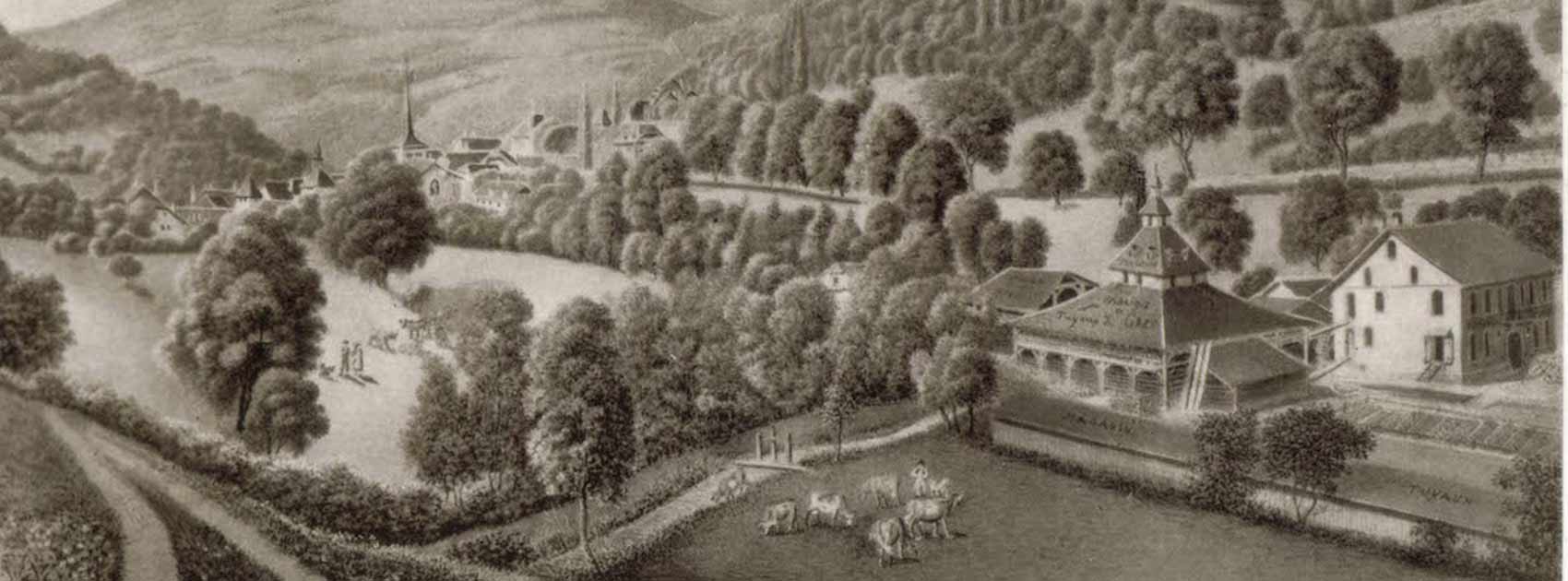
The Village of Romainmôtier
Surrounded by forests, nestled at the bottom of a valley and crossed by a beautiful river, the picturesque village of Romainmôtier rises from the heart of the combe like a timeless megalith, recalling the one at Les Gottettes not far from the Abbey Church, and bearing witness to a rich and surprising history.
Prehistoric traces have already been found in the region, and the area also carries the legacy of the Gallo‑Roman period of European antiquity.
The origins of the village — including its name — are linked to a legend from the 5th century, which connects the religious foundations of the site to Saint Romain and his brother Saint Lupicin. According to tradition, they sought a secluded place at the foot of the Jura Mountains where they could establish a monastery inspired by the example of the Desert Fathers.
Once the religious foundations of the site were established, what we now know as the Abbey experienced many transformations over the centuries: fires at the end of the 13th century and the Bernese invasion in 1536. It was not until the turn of the 19th to the 20th century that the first major restoration took place, followed by another extensive restoration in the 20th century lasting nine years, after which the building became an ecumenical place of worship.
In 2019, a historic building in the region was acquired by the company Henosis.
Photograph of the house in the 19th century – author and date unknown.
The Domaine en Praël
The earliest historical traces suggest that the site where the building stands was initially used by monks until the 16th century, after which it fell into obscurity.
In 1835, Maurice Lerber, a wealthy local bourgeois, decided to invest in the village and established several industries on the site: a foundry, sawmill, forges, drying facilities, and brickworks. With seemingly endless ideas, Mr. Lerber developed a diversified industrial complex that employed more than 180 people by 1865.
However, its industrial history was relatively short-lived. By 1907, due to a lack of raw materials and financial resources, the company was forced to close. The auxiliary buildings were demolished, leaving only the main structure standing.
The property then passed into private hands. For a short period, fish farming was practiced there thanks to the waters of the Nozon River, before the site underwent a complete transformation at the beginning of the second millennium.
With such a rich and varied past, the place still carries a strong historical spirit. Even though the last visible traces of this bygone era are now barely perceptible, its soul remains.
Our mission is to honor the beauty and uniqueness of the Domaine by bringing culture and humanism to life here—values we hope will accompany the transformations of this new millennium toward a more humane world.
GAUDART, Michel, , Romainmôtier, l’abbatiale, au passé (re)composé , p. 1 + Romainmotier histoire de l’abbaye p. 28.
TUSCHER, J.-P., JUNOD, R., Histoire de Romainmôtier, Morges, Editions Cabédita, collection “sites et villages Vaudois”, 1988, p. 192.
MOREROD, Jean-Daniel, Romainmôtier Histoire de l’abbaye, Lausanne, Bibliothèque Historique (collection dirigée par Antoine Rochat N°120 Vaudoise), 2001, pp. 13-22.
